Growing Area
Wine-growing regions of Austria
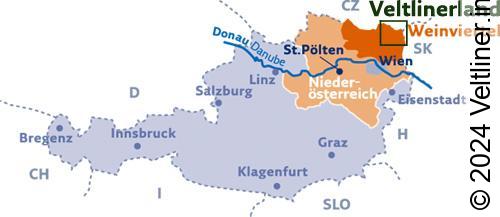 The biggest wine-growing area is the Weinviertel, with about 13.400 hectares, it occupies about a third of the whole wine-growing surface of Austria. With an area of 17 % the area of the Neusiedlersee ranks second. With 8 % of the whole wine-growing surface of Austria the Kamptal and the Neusiedlersee-Hügelland belong to the top 3. Wagram, Southeaststyria, Kremstal, Thermenregion and Mittelburgenland have a surface between 1,400 and 2,500 hectares. Wachau and Souteaststyria occupy 3% of the whole wine-growing surface. Carnuntum and Traisental have a surface of 900 and 800 hectares of viniculture. The smallest wine-growing areas of Austria are Weststyria and Southburgenland with 500 hectares and Vienna with 600 hectares. Vienna, Weststyria and Southburgenland only occupy about 1% of the whole wine-growing surface.
In the following the wine-growing areas of Austria are described in more detail.
Weinviertel
As already mentioned, one third of the whole Austrian grape-surface is occupied the biggest wine-growing area of Austria – the Weinviertel. There is a variety of ground types given: Loess soils, black earth grounds, clay grounds, sandy soil and primary rocks grounds. In the Weinviertel a temperate continental climate dominates in general and areas in the south and southeast profit from the Pannonian climate. The Weinviertel is divided into three parts: the Veltlinerland, the Weinviertel West and the Weinviertel South. The Weinviertel was the first region which decided to introduce the DAC-Sytem.
Kamptal
The landmark of this region is the Heiligenstein. The area is 3.800 hectares big and occupies a surface of 8 %. Not only the location, but also the Kamp are responsible for the quality of the wines. In 2008 the Kamptal DAC was split up into two kinds: “Kamptal DAC” for wines with 12 and 12,5 % alcohol and “Kamptal DAC Reserve” for wines with 13 and more % alcohol. The Kamptal attracts many tourists, because there are many tourist attractions like the Loisium, the Ursin house, but also the castle Gobelsburg or the world of gardens in Schiltern.
Kremstal
The Kremstal, with a wine surface of about 2.200 hectares and a surface share of 5 % of the whole wine surface, extends around the wine town Krems. The pannonian climate provides a quick warming during the day and cool airstreams in the evening. In this area the Grüner Veltliner shines like a diamond, is crispy, elegant and powerful from the primary rocks and exotic and mighty from the loess soils. In 2007 the DAC Kamptal was introduced.
Wachau
The long segment between Melk and Krems, which makes up more than 1,400 hectares and 3 % of the whole wine-growing surface, is called Wachau. The UNESCO appointed the Wachau world cultural heritage; it offers a very high level of quality. The stone terraces are typical of the landscape there. Most of the wine-growers are members of the “Vinea Wachau Nobilis Districtus”. These members are obliged only to own and to sell wines from the Wachau. There are the categories: “Steinfeder”, “Federspiel” and “Smaragd”. The wines of the category “Steinfeder” must not have more than 11 % alcohol. Federspiel-wines have contents of alcohol of beween 11,5 and 12,5 %. Wines of the category “Smaragd” must have 12,5 % alcohol at least.
Traisental
The Traisental cultivates about 800 hectares of wine, which corresponds to 2 % of the whole wine surface. Clearly structured, deep-fruity Grüner Veltliner are produced. Many wine-growers offer “Buschenschank”. This region also has the DAC-status. The DAC wine has to have between 12 and 12,5 % alcohol. The DAC Reserve has about 13 % and more.
Wagram
This wine-growing area plants about 2.500 hectares of wine, which amounts to 5 % of the whole wine-growing surface of Austria, two thirds of the land suitable for cultivation of the area are planted with the dominating Grüner Veltliner. Two brand communities have been formed: the union „Wagramer Selektion” and the winegrower's community "Weingüter Wagram".
Vienna
At a surface of about 600 hectares the Federal capital Vienna produces wine. This corresponds to a wine surface of about 1%. The "WienWein" group has provided a marketing push in the Federal capital. The large part of Vienna’s viniculture can be found in the north of the town. Wine bars, also called “Buschenschanken”, play a big role in Vienna. The most important wine bar places are Stammersdorf, Strebersdorf, Jedlersdorf, Nussdorf, Grinzing, Sievering, Salmannsdorf and Neustift.
Thermenregion
The wine-growing area Thermenregion, being situated to the south of Carnuntum, stretches itself above a surface of 2,200 hectares. Unfortunately, the wine region is often seen as a wellness and relaxing region. You can find not only spas but also many excellent wine bars and restaurants in these surroundings. You can find the tasty Grüner Veltliner with almost every vineyard or wine bar.
Carnuntum
Carnuntum stretches itself out on a surface of 900 hectares. It possibly occupies 2% of the whole wine-growing surface. You can divide the region into two parts: Göttlesbrunn and Höflein. The Grüner Veltliner is cultivated on 36 % of the whole wine-surface. Although the red wine is very important, some wine-growers attach great value to the Grüner Veltiner. In 2006 the “White Wine Fashion-Party” was organized.
Burgenland
The wine-growing area Burgenland spreads out on a surface of about 13.900 hectares. It occupies a wine surface of a total of 31% (Neusiedlersee-Hügelland, Neusiedlersee, Mittelburgenland and Südburgendland) of the whole vineyard-surface. In the Burgenland the Grüner Veltliner has a very high value. With a portion of 18% of the whole vineyard-surface the GV ranks in the top field.
Styria
With a vineyard-surface of 4.240 hectares and a surface portion of 9% of the whole wine-growing surface, Styria is one of the bigger areas. The wine-growing area is divided into three regions: Southeaststyria, Southstyria and Weststyria. Styria cultivates Welschriesling, Morillon, the Müller-Thurgau and the Blaue Wildbacher-Rebe, therfore a tasty rosy wine is generated, the Schilcher.